
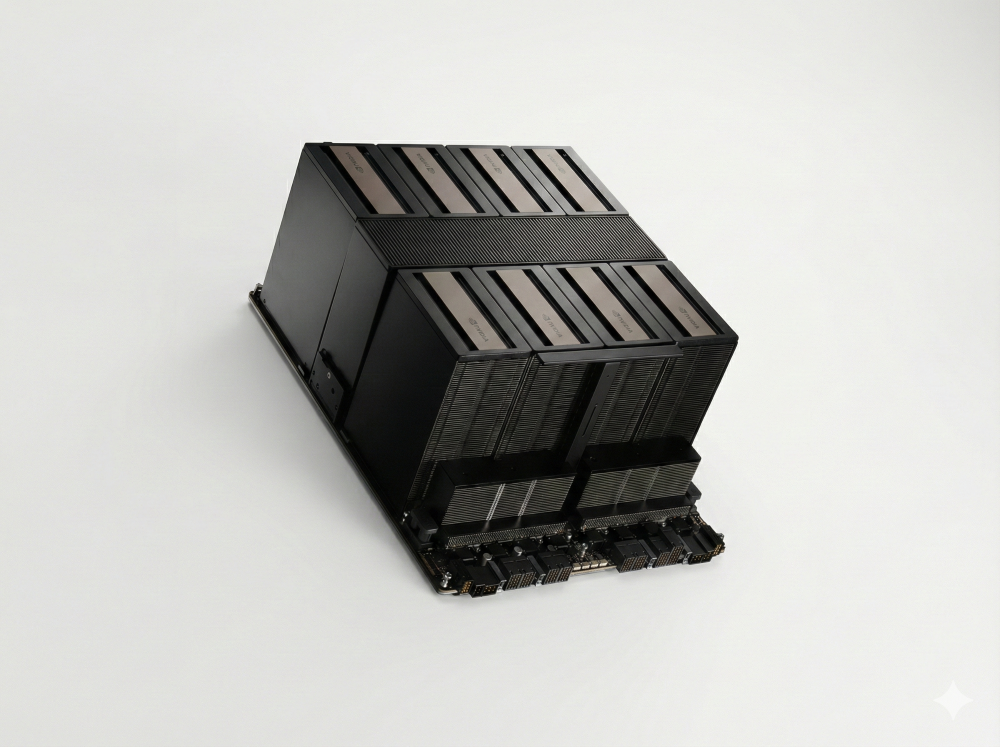


The NVIDIA HGX™ B300 system is more than an incremental update; it is a platform engineered for the reasoning era of AI, where performance is defined by sustained long-context attention, multi-step inference, large KV caches, and low-latency GPU coordination rather than peak FLOPS alone. As models move beyond next-token prediction toward long-context reasoning, planning, and multimodal agentic workflows, system bottlenecks shift from raw compute to memory bandwidth and interconnect efficiency.
Corvex now offers the NVIDIA HGX B300as part of our AI Factory program; dedicated, single-tenant environments designed to solve the "last mile" of hardware performance. By combining NVIDIA Blackwell Ultra’s architectural advancements with Corvex’s optimized industrial-scale networking, we enable enterprises to move beyond experimental clusters into predictable, high-utilization production.
What’s New in NVIDIA HGX B300, and Why It Matters
As the NVL16 and NVL8 designations suggest, the NVIDIA HGX B300 architecture emphasizes tightly coupled NVIDIA NVLink-connected GPU domains, allowing multiple NVIDIA Blackwell Ultra GPUs to function as a unified, high-bandwidth compute fabric rather than as loosely connected devices. An NVIDIA HGX B300 NVL16 baseboard integrates eight SXM modules, each containing a dual-die NVIDIA Blackwell Ultra GPU, for a total of sixteen interconnected GPU dies. The HGX B300 NVL8 configuration uses four SXM modules (eight dies), retaining the same NVLink 5 high-bandwidth topology at half the scale.
This architectural shift materially improves model-parallel scaling efficiency. Large models can keep parameters, activations, and KV caches resident within a unified NVLink fabric, reducing synchronization overhead and minimizing costly data movement. For frontier-scale LLMs and memory-intensive diffusion models, this leads to more consistent step times, higher effective utilization, and reduced cost per training or inference run.
By removing interconnect bottlenecks at the hardware level, NVIDIA HGX B300 allows AI teams to focus on model design and optimization rather than infrastructure workarounds.
Performance Characteristics That Drive Real-World Efficiency
The advantages of NVIDIA HGX B300 extend beyond peak throughput and directly address the constraints that dominate large-scale AI operations:
- Memory bandwidth and capacity: Support for up to 2.1 TB of HBM3e enables long-context inference, larger batch sizes, and more stable training dynamics by reducing off-chip memory access.
- NVLink 5 fabric: With 1.8 TB/s per GPU and 14.4 TB/s across the baseboard, NVLink 5 reduces memory access latency and improves collective communication efficiency for transformer and diffusion workloads.
- Integrated 800G networking: NVIDIA ConnectX-8 SuperNICs and PCIe Gen6 provide high-throughput, low-latency communication between nodes, reducing wall-clock time and improving convergence in distributed training.
In practice, these capabilities translate into fewer GPUs required per job, faster iteration cycles, and lower cost per token, which are key metrics for teams deploying large-scale AI systems in competitive or regulated environments.
When the NVIDIA HGX B300 Makes Sense: NVIDIA B300 NVL16 vs. B300 NVL8
NVIDIA HGX B300 NVL16
NVIDIA HGX B300 NVL16 is the better choice for workloads constrained by memory bandwidth, inter-GPU communication, or model-parallel scaling efficiency, where tight NVLink coupling across a larger GPU domain materially improves performance. Common scenarios include:
- Frontier-scale LLM training (100B+ parameters), where NVLink-connected GPUs reduce all-reduce overhead (all-reduce, all-to-all), improve gradient synchronization efficiency, and shorten step times at scale.
- Large text-to-image and text-to-video diffusion models benefit from higher aggregate memory bandwidth, larger activation footprints, and accelerated cross-node communication during attention and U-Net stages.
- Agentic and multimodal AI systems with long-context attention, large KV caches, and complex tool-calling workflows that demand sustained bandwidth and low-latency GPU-to-GPU communication.
- High-assurance and regulated AI workloads in finance, healthcare, and the public sector, where deterministic performance, hardware isolation, and secure multi-GPU execution are required within a single, tightly coupled system.
NVIDIA HGX B300 NVL8
NVIDIA HGX B300 NVL8 is optimized for performance-dense workloads that benefit from the NVIDIA Blackwell generation’s compute and memory improvements not requiring a full 16-GPU NVLink domain. It is well suited for:
- Mid-to-large-scale LLM training and fine-tuning (10B–70B parameters), where strong single-node scaling and high memory bandwidth deliver excellent price-performance without the complexity of larger GPU domains.
- High-throughput inference and serving, including batch inference, real-time generation, and retrieval-augmented generation (RAG) pipelines that prioritize tokens-per-second, latency consistency, and cost efficiency.
- Enterprise AI and applied ML workloads, such as recommender systems, ranking models, and domain-specific foundation models that scale efficiently within the 8 GPU NVLink topology.
- AI development, experimentation, and iterative training, where teams want NVIDIA Blackwell-generation performance, faster iteration cycles, and simpler cluster orchestration.
Why NVIDIA Blackwell Ultra vs. Hopper
Compared to NVIDIA Hopper-class systems, NVIDIA Blackwell Ultra systems deliver more stable scaling, higher sustained throughput, and improved price-performance, often reducing total cost of ownership even before accounting for energy efficiency, smaller cluster sizes, or simplified system architectures.
Software Stack: From Disk to Decoder
Achieving sustained performance on NVIDIA HGX B300 requires a software stack capable of feeding the hardware at full speed and also streamlines cluster management. Corvex integrates NVIDIA’s Magnum IO stack end-to-end to eliminate CPU bottlenecks and reduce latency variance across the data path.
NVIDIA GPU Direct® Storage and RDMA stream data directly into GPU memory at up to 1.6 TB/s, keeping Tensor Cores fully utilized during training and inference. NVIDIA TensorRT-LLM and cuDNN v9 are tuned for NVIDIA Blackwell system’s FP8 and FP4 execution paths, enabling high throughput while maintaining numerical stability. MIG support allows GPUs to be partitioned into isolated, predictable slices for secure inference or right-sized compute allocation without sacrificing efficiency.
Corvex’s managed Kubernetes provides a practical way to deploy and operate multiple Kubernetes clusters within a single hardware environment. It supports separating workloads into independent clusters or sub-tenants with minimal performance overhead, while centralizing management across deployments. Clusters can be treated as ephemeral or long-lived depending on operational needs, and are accessible through both a unified interface and standard CLI tooling, enabling consistent workflows without adding platform complexity.
This tightly integrated stack allows customers to deploy advanced AI workloads on NVIDIA HGX B300 systems without refactoring pipelines, while achieving higher utilization and more deterministic production behavior.
The Corvex Advantage: Performance, Reliability, and Security at Scale
At Corvex, performance is inseparable from efficiency, security, and scale. NVIDIA HGX B300 infrastructure is deployed in dedicated, single-tenant environments designed to eliminate noisy neighbors, reduce performance variance, and maximize usable throughput per system. These deployments are engineered to support AI Factory–scale clusters, even in a market constrained by limited data center power availability and sub-one-percent vacancy rates. By combining hardened network segmentation, strict policy controls, and continuous compliance reporting with the ability to secure large-scale capacity on accelerated timelines, Corvex delivers predictable performance and operational trust without being gated by prevailing infrastructure bottlenecks..
For sensitive workloads, Corvex supports hardware-level Confidential Computing through Trusted Execution Environments (TEEs) embedded directly into NVIDIA Blackwell GPUs. These TEEs encrypt data in use and enable remote attestation, allowing customers to verify that workloads are running on authentic, uncompromised hardware. As a result, proprietary models, training data, and customer inputs remain protected—even in sovereign or highly regulated AI deployments.
A New Architectural Baseline for Enterprise AI
The NVIDIA HGX B300 establishes a new baseline for enterprise-grade AI infrastructure, designed not only for faster training and inference, but for large-scale reasoning, planning, and complex decision-making workloads. With Corvex, customers gain the full capabilities of Blackwell Ultra GPUs alongside the efficiency, security, and operational control required to deploy these systems with confidence at scale.
Ready to evaluate NVIDIA HGX B300s with Corvex?
Contact us to schedule a proof of concept or pricing consultation.








.png)
-p-500%201.png)

.svg)
.svg)